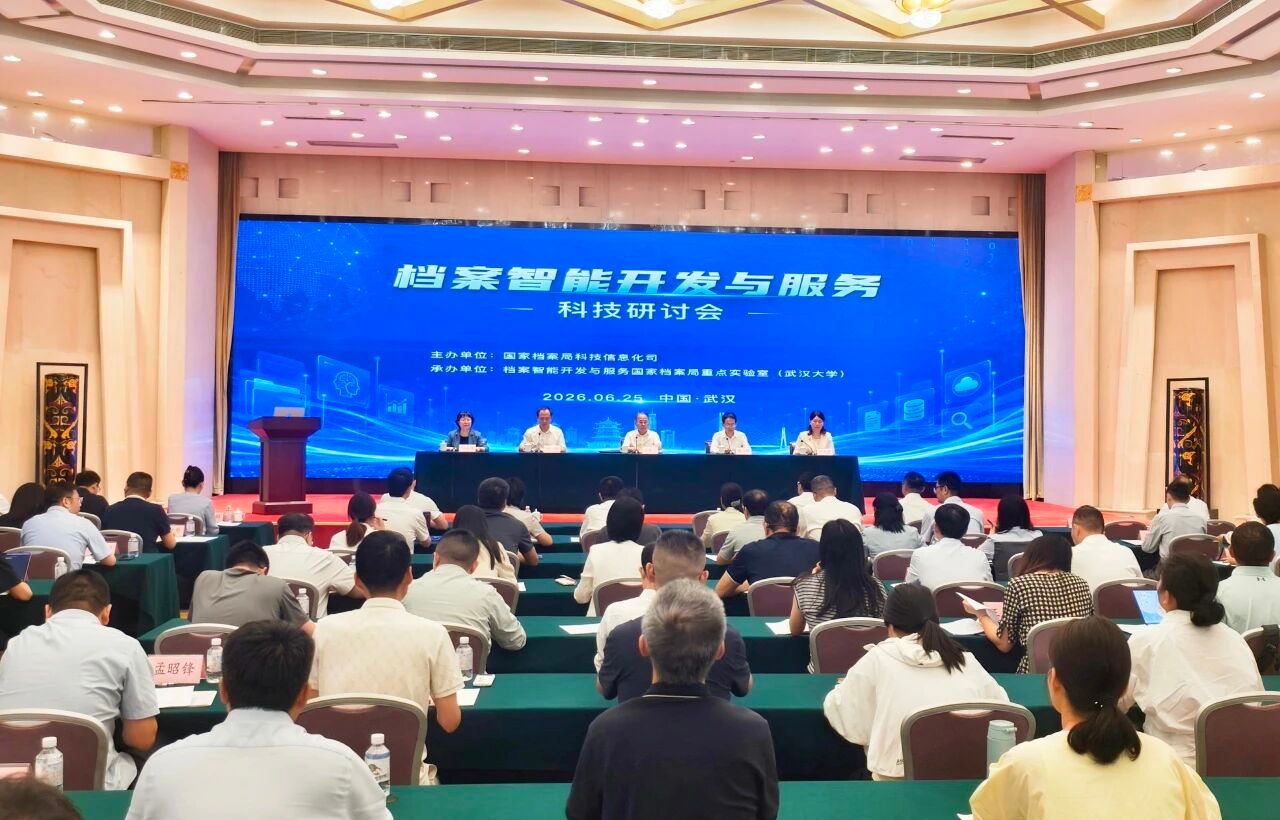
On June 25, the "Intelligent Development and Service of Archives" Science and Technology Symposium was held in Wuhan. It was hosted by the Department of Science, Technology and Informatization of the National Archives Administration of China and organized by the National Archives Administration Key Laboratory of "Intelligent Development and Service of Archives" at Wuhan University. Zhenyi Lin, Deputy Curator of the Central Archives and Deputy Director of the National Archives Administration of China, attended the meeting.
This symposium was a concrete action to implement the "National Archives Development Plan for the 15th Five-Year Plan Period" and the "Opinions on Promoting the Application of Artificial Intelligence in the Archives Industry". It was also the second symposium after the "Data Archiving and Archival Security" Science and Technology Symposium held in December last year. It aimed to deepen understanding of the development trends of artificial intelligence, exchange practical experience, explore paths for technology application, and promote the application of artificial intelligence in the archives industry in a safe, steady and orderly way.
The meeting pointed out that in recent years, archives departments at all levels have actively carried out practices in the application of artificial intelligence, with in-depth exploration in more than 10 business scenarios such as archival arrangement, description, declassification and desensitization, open review, and compilation and research. AI-assisted archival work has achieved positive results, and the application of artificial intelligence in the archives industry shows a good trend of development.
The meeting stressed the need to earnestly implement the requirements of the archives development plan for the 15th Five-Year Plan period on accelerating the digital transformation of archival work, to expand "Artificial Intelligence + Archives", and to use digital and intelligent technologies to empower archival work. At the same time, it is necessary to balance development and security, to put security first in archival informatization work, to firmly hold the security bottom line in practical applications, and to ensure that no security incident occurs with archival data. Supervision of artificial intelligence applications must be strengthened, so that they help solve pain points and difficulties in archival work within a reasonable scope and improve the quality and efficiency of work. Manual review of the results of artificial intelligence applications must be increased, the explainability and verifiability of artificial intelligence must be upheld, and the initiative in the secure application of artificial intelligence must be firmly kept. The working principles of "actively exploring applications, ensuring security and confidentiality, focusing on key areas, avoiding a rush to follow trends, and emphasizing practical results and economy" must be followed, so as to achieve a reasonable balance between application and security.
In the discussion session, 11 experts and scholars from the Liaoning Provincial Archives, the Shanghai Municipal Archives Bureau, the Zhejiang Provincial Archives Bureau, the Shandong Provincial Archives, the Henan Provincial Archives, the Guangdong Provincial Archives, the Wuhan Municipal Archives, Wuhan University, the China Electronics Standardization Institute and China Resources (Holdings) Co., Ltd. gave keynote speeches. The participants exchanged views on topics such as national policies and standards for artificial intelligence, the development of cutting-edge technologies, infrastructure construction and applications in business scenarios, and academic commentators gave comments on site.
More than 70 people attended the meeting, including staff from relevant departments and units of the National Archives Administration of China; staff responsible for archival informatization in the archives departments of all provinces, autonomous regions and municipalities directly under the central government, the Xinjiang Production and Construction Corps and some sub-provincial cities; and experts and scholars from relevant universities, enterprises and research institutions.