Recently, the team led by Professor Ping Wang, a researcher at the National Archives Administration Key Laboratory of Intelligent Development and Service of Archives and a professor at the School of Information Management, Wuhan University, published at the Association for the Advancement of Artificial Intelligence conference AAAI 2024 its latest research in the field of AI music understanding, titled "N-Gram Unsupervised Compoundation and Feature Injection for Better Symbolic Music Understanding". AAAI is one of the top international conferences in artificial intelligence and is a Class A conference in the China Computer Federation (CCF) classification. Jiajia Li, a 2023 doctoral student in Data Science at Wuhan University, is a co-first author of the paper; Professor Ping Wang is the corresponding author; and Wuhan University is the first affiliation of the paper.
Traditional music AI technologies mostly focus on understanding audio signals, whereas the highlight of this study lies in its innovative approach to symbolic music understanding. The study introduces N-Gram theory into the field of music understanding and proposes a unique Unsupervised Compound Word technique (UCW) aimed at deepening the understanding of symbolic music. At the model architecture level, it introduces the NG-Midiformer model, which incorporates the features of an N-Gram Transformer encoder and greatly enhances the model's ability to recognize and process musical symbols.
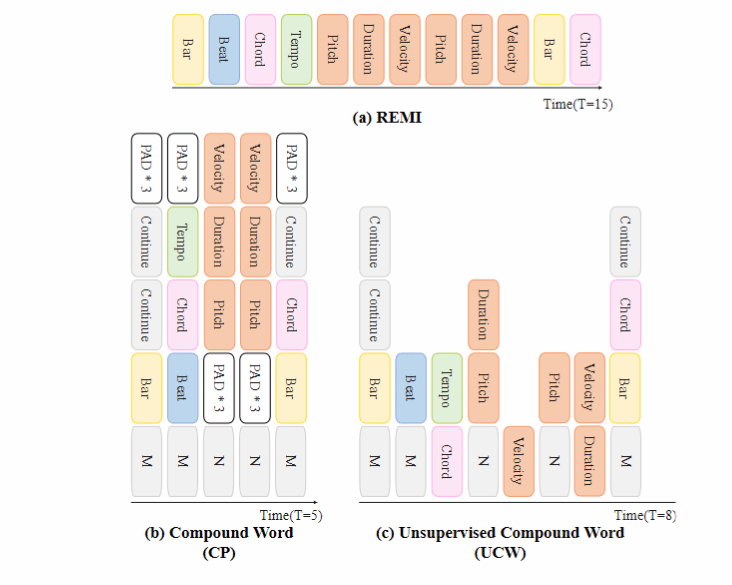
Figure Figure 1 Relationships and differences among REMI, CP and UCW
By applying deep learning and N-Gram techniques, NG-Midiformer can analyze music sequences more deeply and effectively capture the subtle connections between musical elements. In addition, this study introduces a feature injection method that incorporates additional musical feature information into the model. These features may include information such as musical style and emotion, which helps improve the understanding and generation of music. By using N-Gram unsupervised compoundation and feature injection, this study successfully addresses several problems in symbolic music understanding and generation. These methods can improve the understanding of musical structure and features, thereby better generating music that matches specific styles and emotions. The model performs excellently on multiple public datasets, achieving state-of-the-art results.
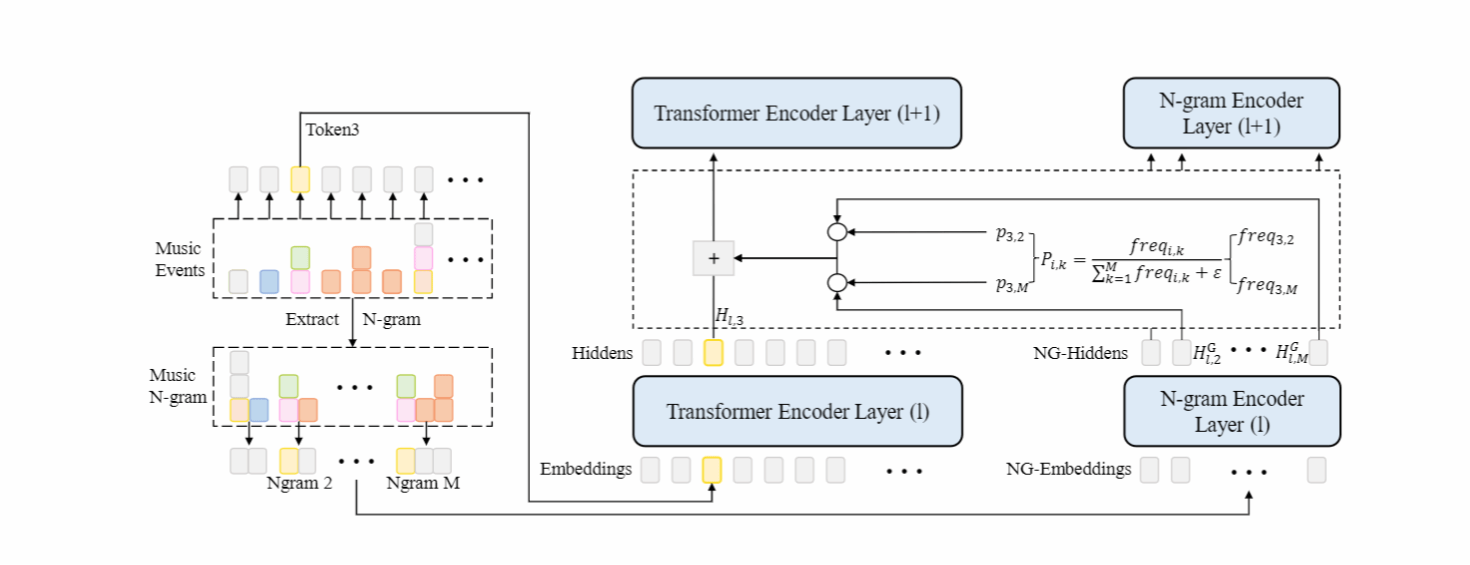
Figure 2 Overall architecture of the N-gram Transformer encoder
This paper provides new research perspectives and methods for the field of symbolic music understanding. By combining natural language processing techniques with the specific needs of the music domain, it creates new means for applying AI to music understanding. The Key Laboratory of Intelligent Development and Service of Archives has always been committed to transforming cutting-edge technology into a practical force driving social development. We hope that the research results will bring more possibilities for the integration of music, art and technology, and jointly open a new chapter in the combination of music AI and data science.
This research was supported by the National Natural Science Foundation of China, the Natural Science Foundation of Hubei Province, the Fundamental Research Funds for the Central Universities and other projects.